
The Social Power of Card Games: Why They Still Matter
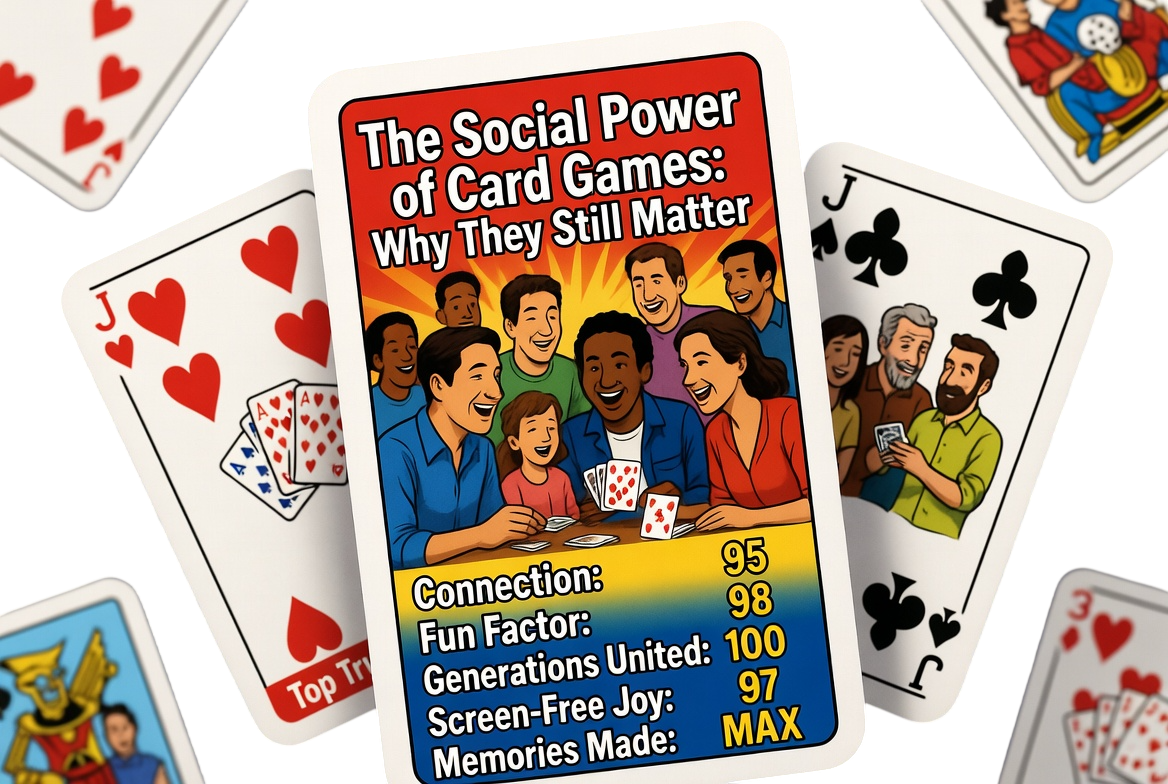
How Card Games Keep Us Connected in a Digital World
In an age dominated by digital entertainment, card games remain one of the most enduring and universal ways people connect. Whether played around a kitchen table, in a school playground, or during a family gathering, card games have a remarkable ability to bring people together. They are simple to learn, endlessly adaptable, and deeply social — and their importance in society is far greater than many realise. At a time when screens often pull people apart, card games quietly continue to do the opposite: they draw people closer.
At their core, card games create shared experiences. Unlike solitary digital activities, card games require people to sit together, talk, laugh, negotiate, and compete. They encourage eye contact, conversation, and genuine human interaction. A deck of cards doesn’t care about age, background, or skill level; everyone starts with the same tools, and everyone has the chance to win. This creates a sense of inclusion that few other forms of entertainment can match. Children, parents, and grandparents can all participate on equal footing, making card games one of the rare activities that truly span generations.
This intergenerational aspect is one of the most powerful features of card games. In many families, card games become traditions passed down through decades. A child might learn a game from a parent who learned it from their own parent. The rules, the rituals, the inside jokes — they all become part of a shared family culture. These games become more than entertainment; they become memories. They become the stories people tell years later: the time someone bluffed their way to victory, the time a grandparent revealed a secret strategy, the time a child unexpectedly beat everyone at the table. These moments matter because they are rooted in togetherness.
Card games also encourage face‑to‑face interaction, something increasingly rare in modern life. The simple act of gathering around a table fosters conversation and strengthens relationships. Even competitive games create bonds — the friendly rivalry, the shared tension, the dramatic victories and defeats. These moments become stories people remember and retell, reinforcing social ties. In a world where so much communication happens through screens, card games offer a refreshing return to physical presence and genuine connection.
Among the many types of card games, Top Trumps–style games hold a special place. Their appeal lies in their elegant simplicity: each card represents a character, object, or theme, and players compete by comparing stats. This format is instantly accessible, yet surprisingly strategic. Players must decide which category to choose, when to take risks, and how to outthink their opponents. It’s competition distilled into its purest form. The rules are simple enough for children to grasp quickly, yet the strategic depth keeps adults engaged. This balance is one of the reasons Top Trumps–style games have remained popular for decades.
But Top Trumps–style games offer more than entertainment. They are powerful learning tools. Children absorb information effortlessly while playing — whether it’s animals, planets, historical figures, or fictional characters. The stats spark curiosity, encouraging players to compare, question, and remember facts. Even adults benefit from the quick mental calculations and strategic thinking these games require. They sharpen memory, improve decision‑making, and develop pattern recognition. In many ways, these games teach without feeling like teaching, which is one of the most effective forms of learning.
The collectible nature of these games also adds a layer of engagement. Building a deck, discovering new cards, and debating which ones are strongest creates a sense of ownership and personal expression. For many people, these games become part of their cultural memory — a nostalgic link to childhood, school playgrounds, and rainy afternoons spent battling friends. The excitement of opening a new pack, the pride of finding a rare card, the thrill of finally winning a long‑running rivalry — these experiences stay with people for life.
Card games also play an important role in developing social skills. They teach patience, turn‑taking, fairness, and resilience. They teach people how to win gracefully and lose with humour. They teach negotiation, reading other players, and managing emotions. These are skills that extend far beyond the game table. In a world where many interactions are mediated by technology, card games offer a rare opportunity to practice these skills in a natural, enjoyable way.
In a broader sense, card games remind us of something essential: human connection doesn’t need screens, subscriptions, or complex technology. All it takes is a deck of cards and a willingness to play. They teach us to take turns, to win gracefully, to lose with humour, and to enjoy the company of others. In a world that often feels fast and fragmented, card games offer a rare moment of togetherness. They slow things down. They create space for conversation. They remind us that some of the best experiences in life are also the simplest.
Whether it’s a classic deck, a modern strategy game, or a custom Top Trumps set, card games continue to enrich society by bringing people closer — one hand at a time. They are more than games; they are bridges between people. They connect generations, strengthen friendships, and create memories that last a lifetime. In a digital world, card games remain a powerful reminder of the joy of human connection.
Let us know in the comments why card games still matter to you.